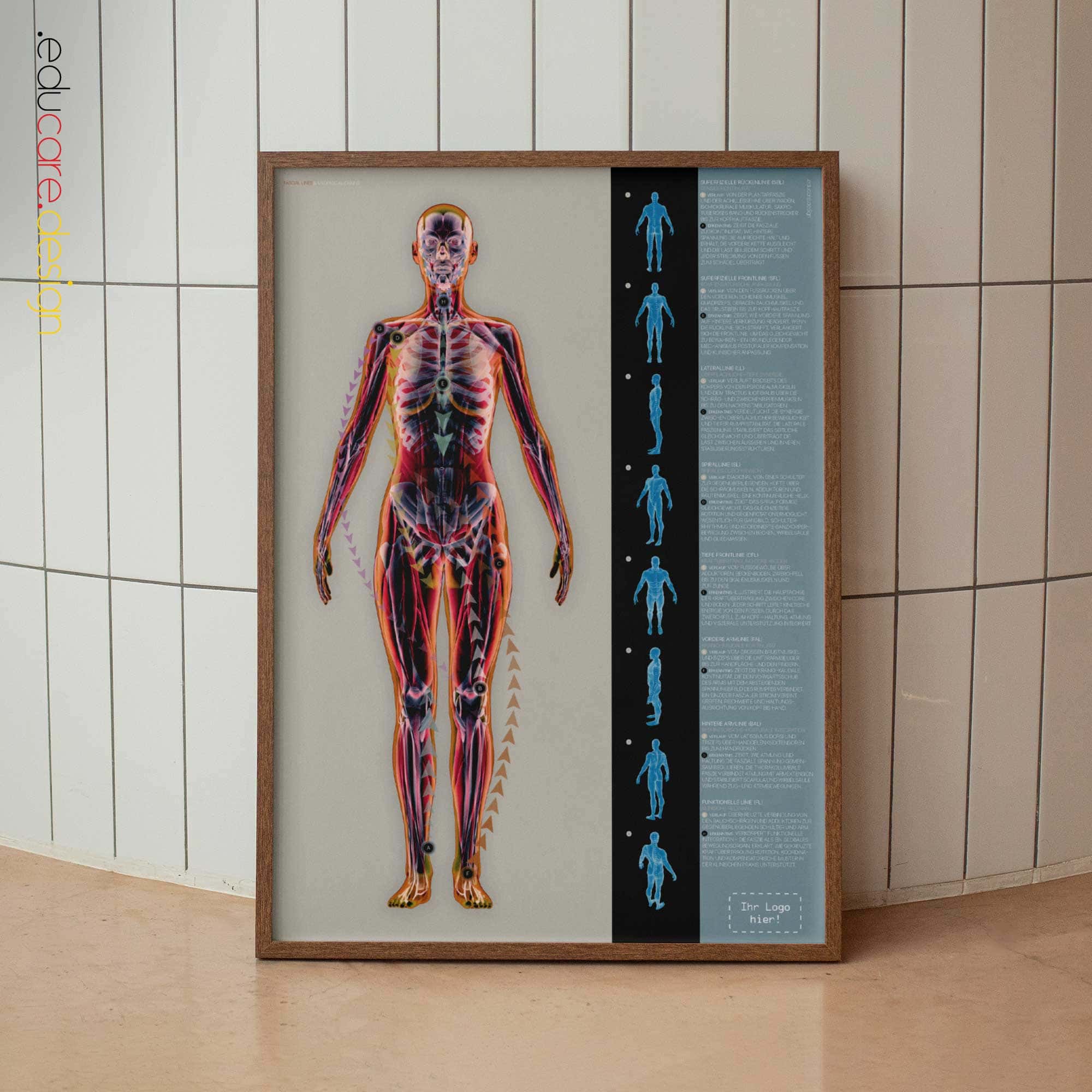
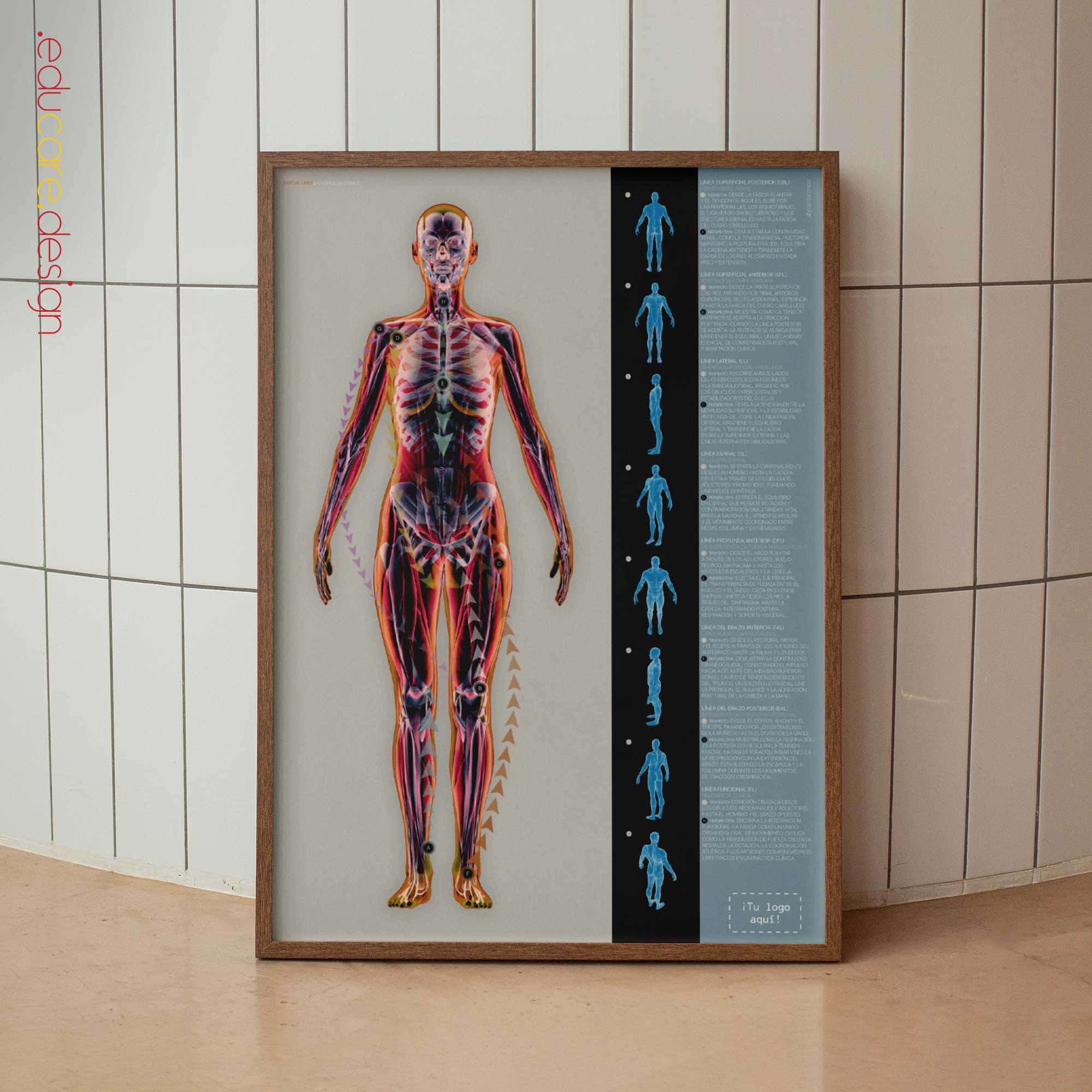
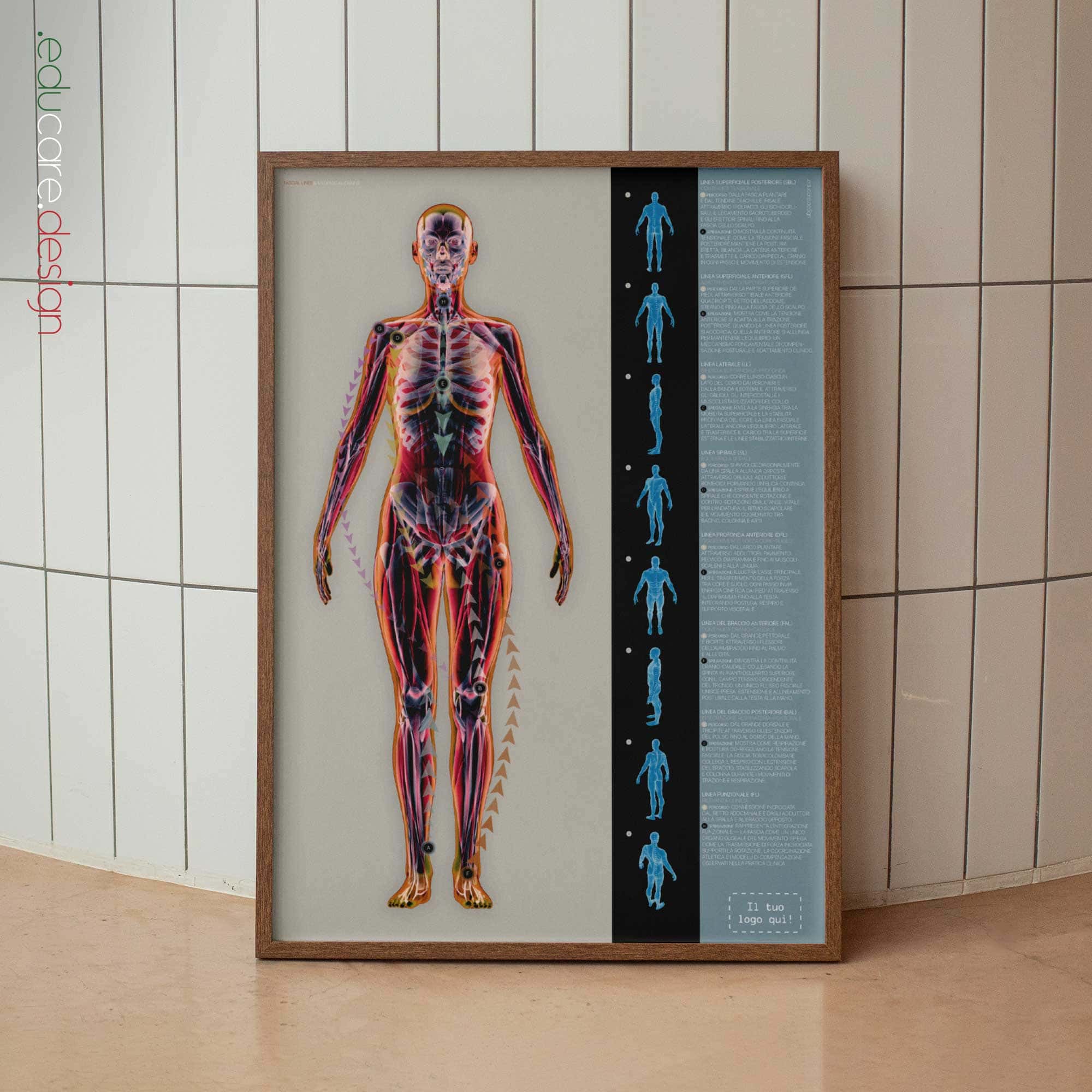
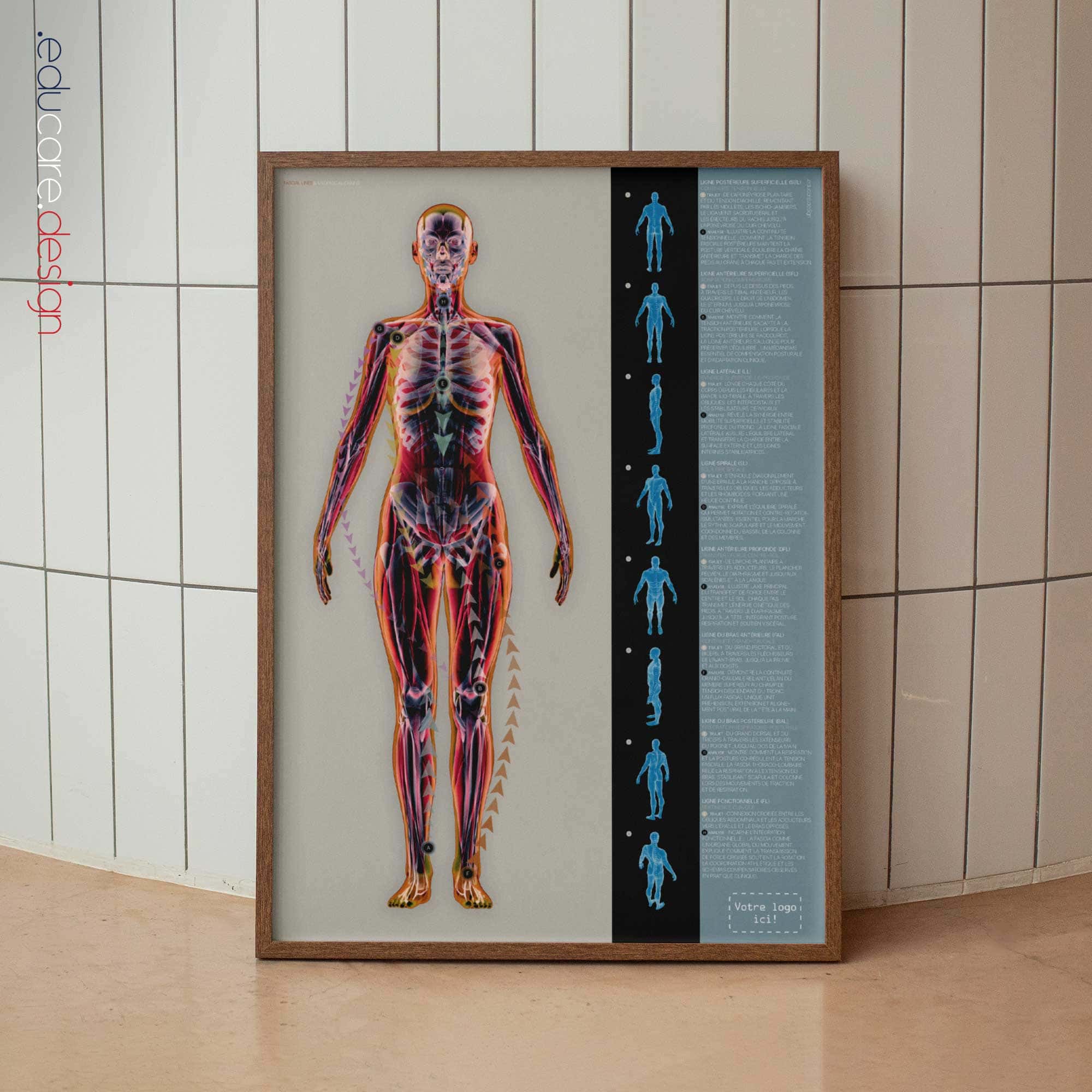
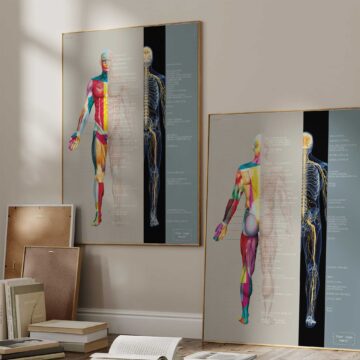
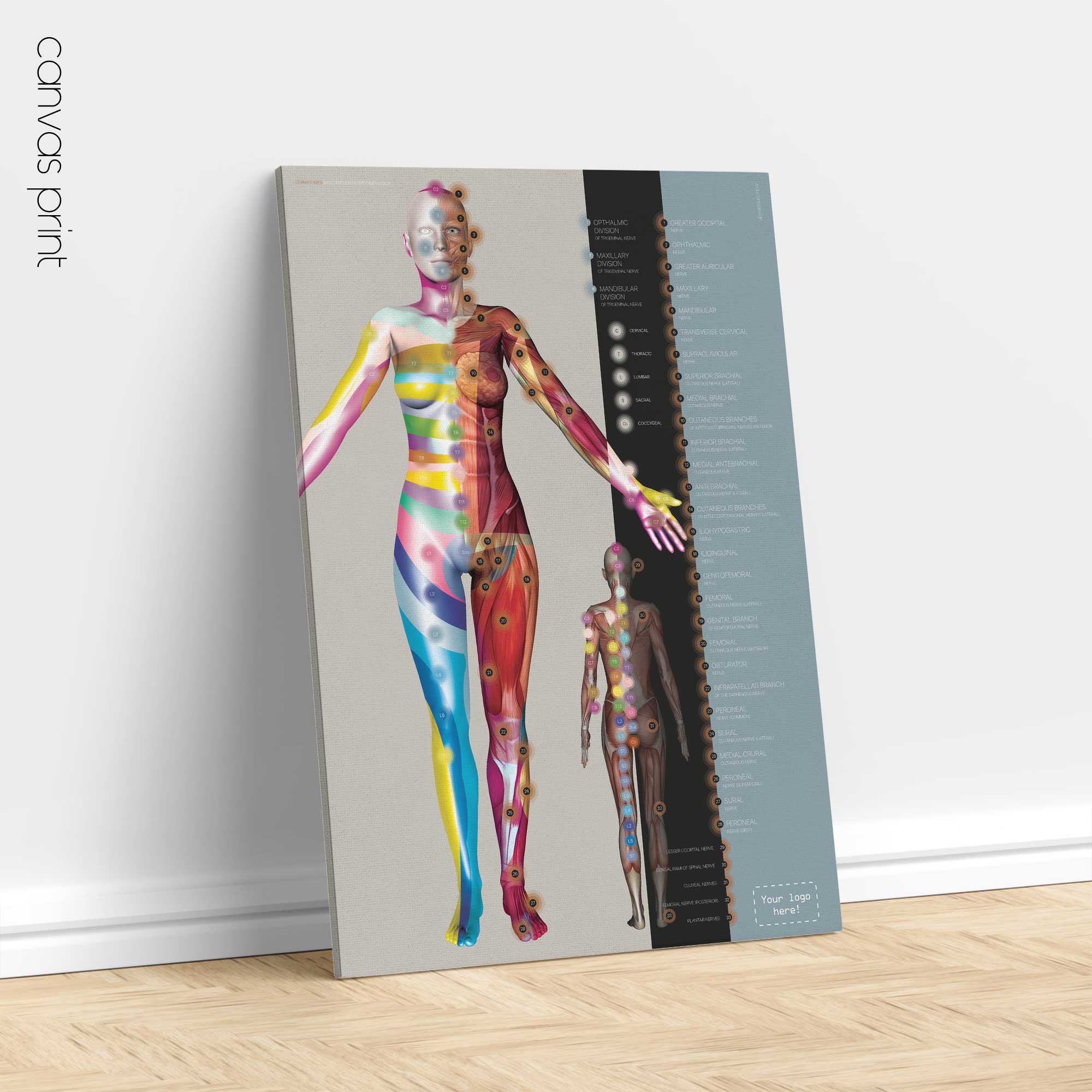
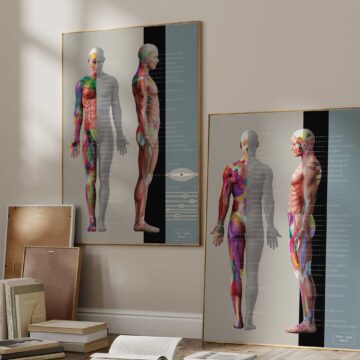
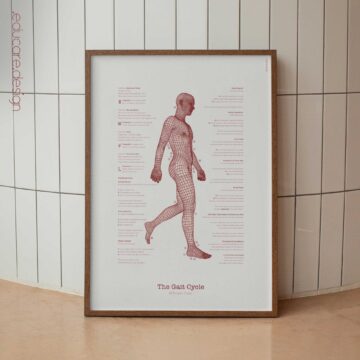
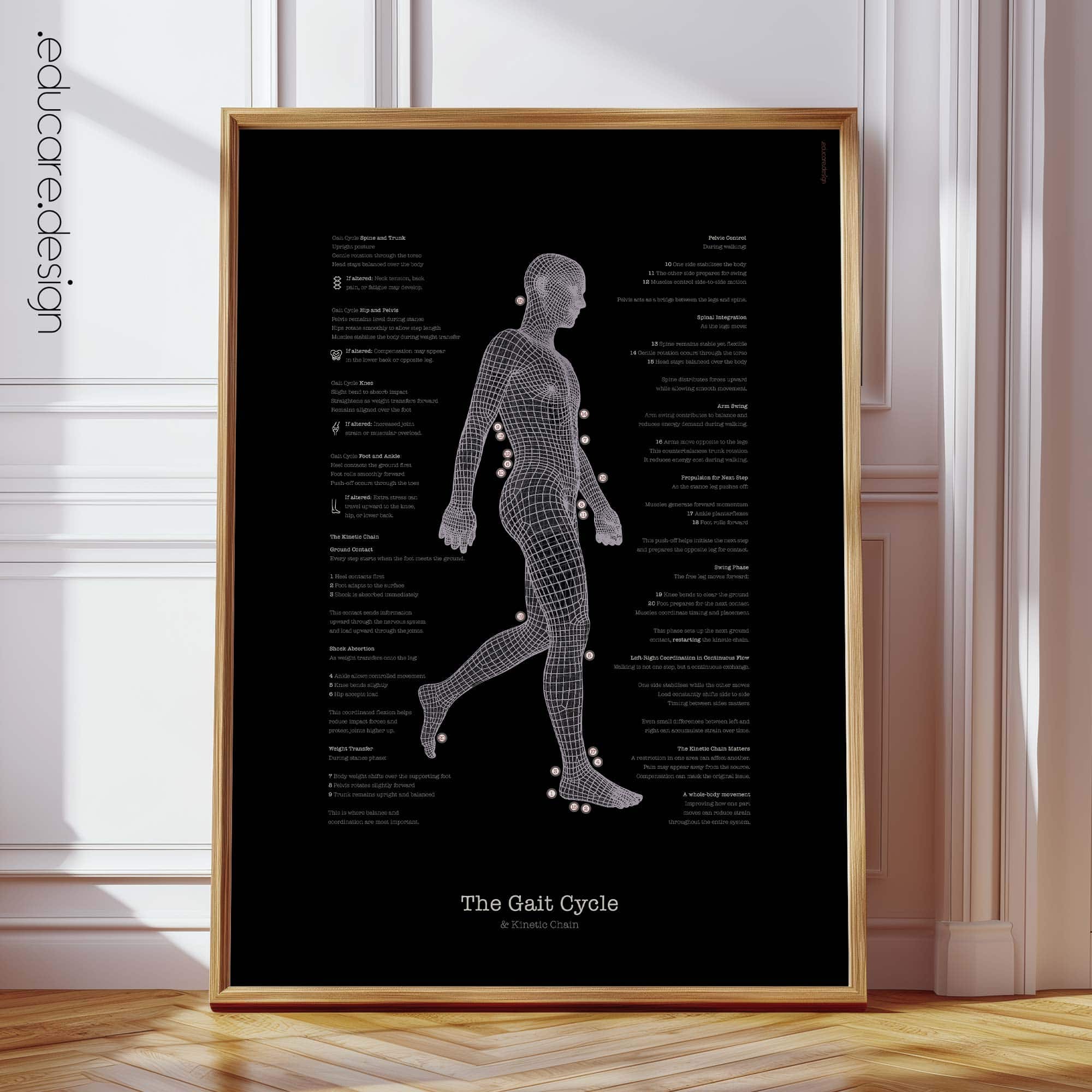
A modern clinical anatomy chart that bridges fascial continuity and functional movement in a clean, educational format. This chart presents the body as an interconnected web of tension and support — showing how myofascial lines transmit force, maintain posture, and coordinate motion from head to toe.
Each fascial pathway (1–8) is illustrated on simplified blue body outlines, revealing the main directional flows — from the Superficial Back Line running heel to skull, to the Deep Front Line that unites diaphragm, pelvis, and cranial base. Alongside these, the main anatomical figure highlights eight Functional Insights (A–H) — demonstrating how fascial tension translates into coordinated balance, rotation, breathing mechanics, and whole-body integration.
This chart separates structure (the anatomical fascial lines) and function (the dynamic load and tension patterns), creating a uniquely clear overview of how the body’s fascial system supports movement, stability, and clinical reasoning.
Function Section (A–H):
Directional arrows and clean markers visualise fascial tension and kinetic continuity — from ground reaction through the legs (A–B) to rotational coupling, diaphragmatic balance, and cranial lift (C–H). Each vector shows a distinct functional principle such as tensional continuity, force transfer, helical rotation, intra-abdominal pressure, and cranial suspension — all key components of integrated movement and posture.
Structure Section (1–8):
The right-hand panel maps the eight principal fascial lines — Superficial, Lateral, Spiral, Deep Front, and Arm Lines — each shown as a simplified body pathway with clear one-line descriptions of origin, route, and function. Minimalist and clinically focused, these allow practitioners to quickly reference or explain fascial relationships without anatomical overload.
Real-World Application.
Clinicians use this chart to demonstrate how tension in one region — such as the calves, hips, or diaphragm — can create compensations and strain along the entire kinetic chain. It transforms complex fascial theory into clear visual logic, supporting patient communication, postural assessment, and functional therapy planning. Perfect for use in chiropractic, osteopathic, and physiotherapy settings, or as an advanced teaching tool in movement and manual therapy education.
Ideal for:
Chiropractic & Osteopathic Clinics — explaining kinetic and fascial continuity to patients.
Physiotherapy & Sports Medicine — assessing movement compensation and strain patterns.
Functional Anatomy & Manual Therapy Teaching — advanced fascia mapping reference.
 View this chart here on YouTube.
🇬🇧 View more details of the English version.
🇮🇹 Vedi i dettagli della versione italiana.
🇪🇸 Ver detalles de la versión en español.
🇩🇪 Details zur deutschen Version anzeigen.
🇫🇷 Voir les détails de la version française.
🇳🇱 Bekijk details van de Nederlandse versie.
🇵🇹 Veja mais detalhes da versão portuguesa.
🇸🇪 Se fler detaljer om den svenska versionen.
🇳🇴 Se flere detaljer om den norske versjonen.
🇩🇰 Se flere detaljer fra den danske version.
Make it part of your clinic!
⬇ Order here.