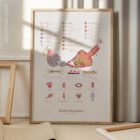
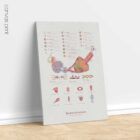
Movement begins with structure. This chart examines skeletal muscle not merely as tissue, but as organised architecture — from macroscopic muscle form to microscopic contractile units.
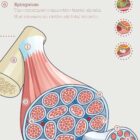
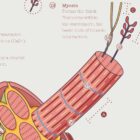
The upper section dissects muscle hierarchy layer by layer. Tendon connects to bone. Muscle belly divides into fascicles. Fascicles contain muscle fibres. Fibres house myofibrils, which in turn are composed of repeating sarcomeres — the fundamental contractile units responsible for force generation. Each structural level is clearly labelled, creating a logical progression from whole muscle to molecular interaction. Detailed illustrations of actin and myosin filaments clarify how sliding filament mechanics produce contraction. The inclusion of Z-discs, cross-bridges and sarcomere boundaries transforms abstract physiology into visible mechanics.
Form Defines Function.
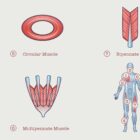
The lower section shifts from internal architecture to external morphology. Skeletal muscles are categorised by shape — convergent, fusiform, parallel, unipennate, bipennate, multipennate and circular. These configurations are not aesthetic variations; they directly influence force production, contraction velocity and range of motion.
By positioning structural classification alongside microanatomy, the chart connects fibre arrangement to functional outcome. Why does a pennate muscle generate greater force? Why does a parallel muscle allow greater excursion? The visual framework makes these distinctions immediately accessible.
Clinical & Educational Application.
This artwork is particularly valuable in environments where explaining biomechanics matters: Rehabilitation clinics, Sports performance facilities, Chiropractic and osteopathic practices, Academic anatomy settings.
It supports discussion of muscle strain, fibre recruitment, architectural efficiency and mechanical adaptation without oversimplifying complexity. Cross-sectional views and labelled microstructures reinforce spatial understanding. Rather than presenting isolated facts, the chart builds a cohesive model of how skeletal muscle is constructed and why that construction matters.
This is not a general muscle poster. It is a structured anatomical framework — designed to clarify muscle architecture, illuminate contraction mechanics and strengthen biomechanical literacy in modern healthcare settings.
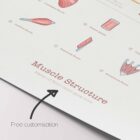
Free customisation with your clinic’s name.
For this chart we offer to add your clinic’s name (or website address) for free! The name will go instead of the current sub-headline on the artwork; view an illustration of this in the image gallery.
 View this chart here on YouTube.
Black Edition.
This chart is available to order in a special black edition, which can be previewed in the image gallery.
🇬🇧 View more details of the English version.
🇮🇹 Vedi i dettagli della versione italiana.
🇪🇸 Ver detalles de la versión en español.
🇩🇪 Details zur deutschen Version anzeigen.
🇫🇷 Voir les détails de la version française.
🇳🇱 Bekijk details van de Nederlandse versie.
🇵🇹 Veja mais detalhes da versão portuguesa.
🇸🇪 Se fler detaljer om den svenska versionen.
🇳🇴 Se flere detaljer om den norske versjonen.
🇩🇰 Se flere detaljer af den danske version.
Make it part of your clinic!
⬇ Order here.