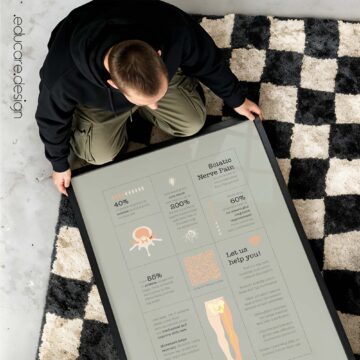
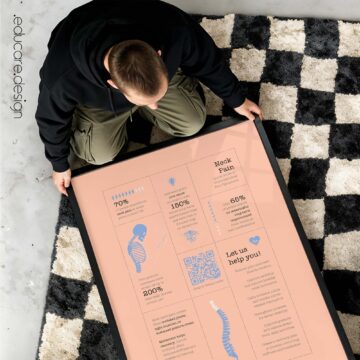
Patient-Friendly Fact Sheet for Modern Clinics.
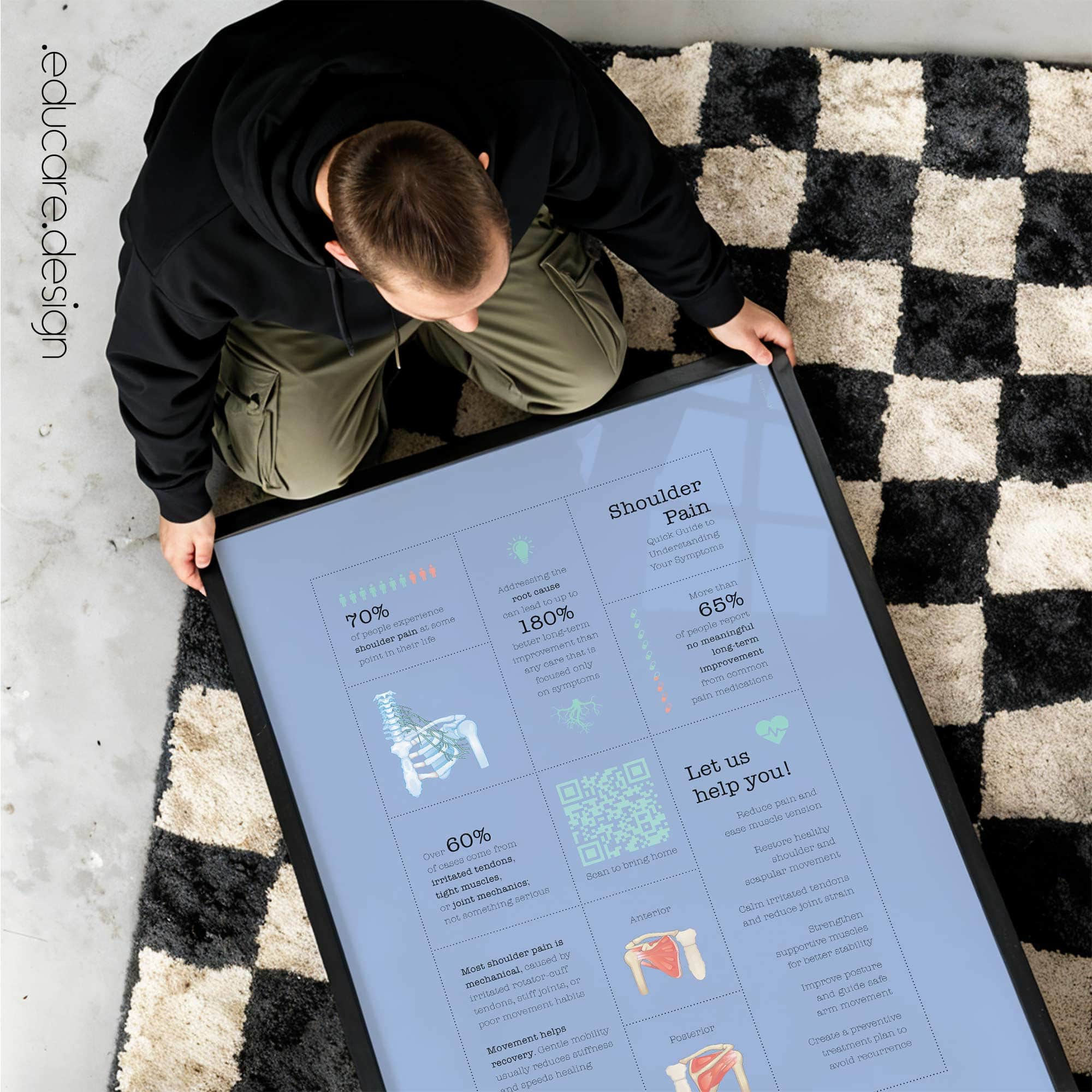
The Shoulder Pain Quick Guide is a clean, patient-oriented poster designed to help your clinic communicate clearly, confidently, and efficiently. Created as part of our Quick Guides collection, this chart turns complex information into simple, trustworthy insights that patients can understand at a glance.
This poster is not a detailed anatomy chart — it is a communication tool. It presents clear facts, reassuring statistics, and easy-to-read guidance that supports your daily explanations and strengthens your clinic’s professionalism.
Why your clinic will love this Quick Guide.
Instant clarity for patients. The poster highlights the most important things patients need to know about shoulder pain — what’s common, what’s not serious, and what actually helps recovery.
Helps communicate a sensible approach. By presenting research-aware facts and root-cause messaging, the chart reinforces your approach to care and positions your clinic as modern, informed, and patient-focused.
Supports your explanations. Simple statements in focus, clear icons, and a calming layout make it easy to point, explain, and guide patients during assessments or follow-ups.
What’s Inside this Quick Guide?
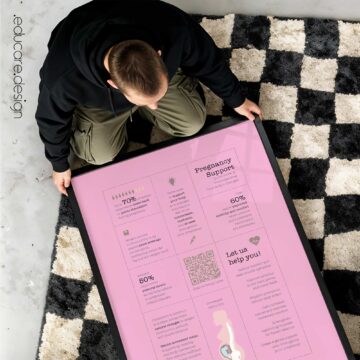
Key statistics patients immediately relate to: ① 70% of people experience shoulder pain at some point in their life. ② Addressing the root cause can lead to over 180% better long-term improvement than any care that is focused only on symptoms. ③ More than 65% of people report no meaningful long-term improvement from common pain medications ④ Over 60% of cases come from irritated tendons, tight muscles, or joint mechanics.
Focus points for those in doubt: ① Most shoulder pain is mechanical, caused by irritated rotator-cuff tendons, stiff joints, or poor movement habits. ② Movement helps recovery. Gentle mobility usually reduces stiffness and speeds healing. ③ Early attention reduces flare-ups and prevents long-term limitation.
How your clinic can help: ① Reduce pain and ease muscle tension. ② Restore healthy shoulder and scapular movement. ③ Calm irritated tendons and reduce joint strain. ④ Strengthen supportive muscles for better stability. ⑤ Improve posture and guide safe arm movement. ⑥ Create a preventive treatment plan to avoid recurrence.
QR Code included for lasting Patient Education.
The built-in QR code on our Quick Guides will let your patients access the guide on their own device, in any of our 10 supported languages — ideal for follow-up and home understanding. 📱 Click here to see what scanning the QR code will show your patients (optimised for mobile viewing).
 View this Quick Guide here on YouTube. Visit the Quick Guides playlist here.
🇬🇧 View more details of the English version.
🇮🇹 Vedi i dettagli della versione italiana.
🇪🇸 Ver detalles de la versión en español.
🇩🇪 Details zur deutschen Version anzeigen.
🇫🇷 Voir les détails de la version française.
🇳🇱 Bekijk details van de Nederlandse versie.
🇵🇹 Veja mais detalhes da versão portuguesa.
🇸🇪 Se fler detaljer om den svenska versionen.
🇳🇴 Se flere detaljer om den norske versjonen.
🇩🇰 Se flere detaljer af den danske version.
Make it part of your clinic!
⬇ Order here.