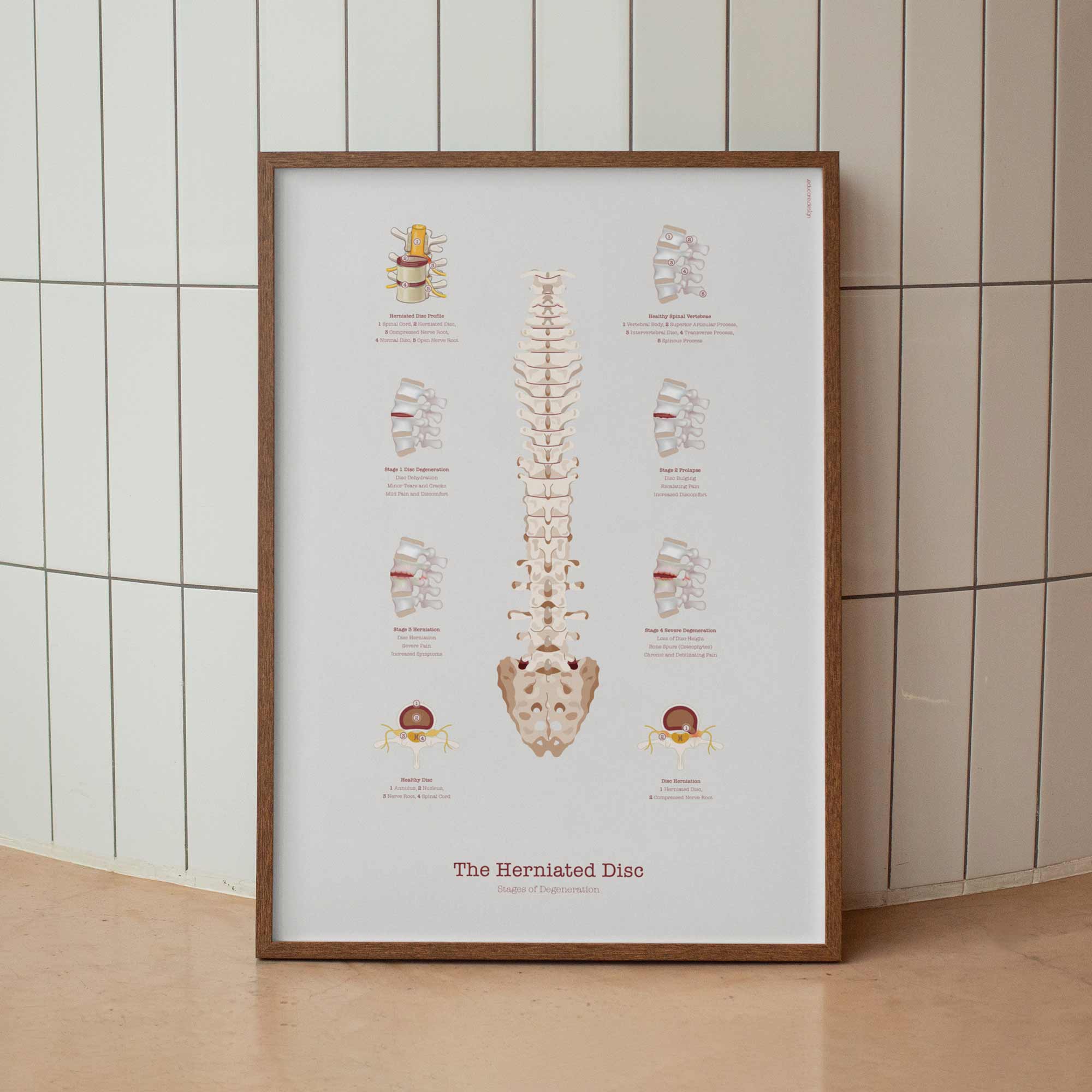
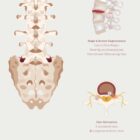
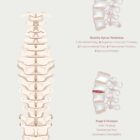
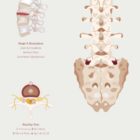
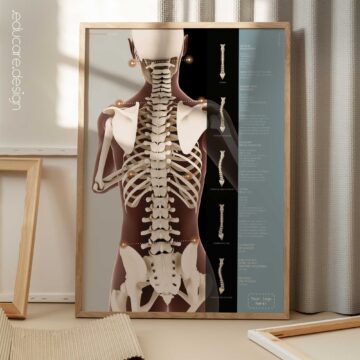
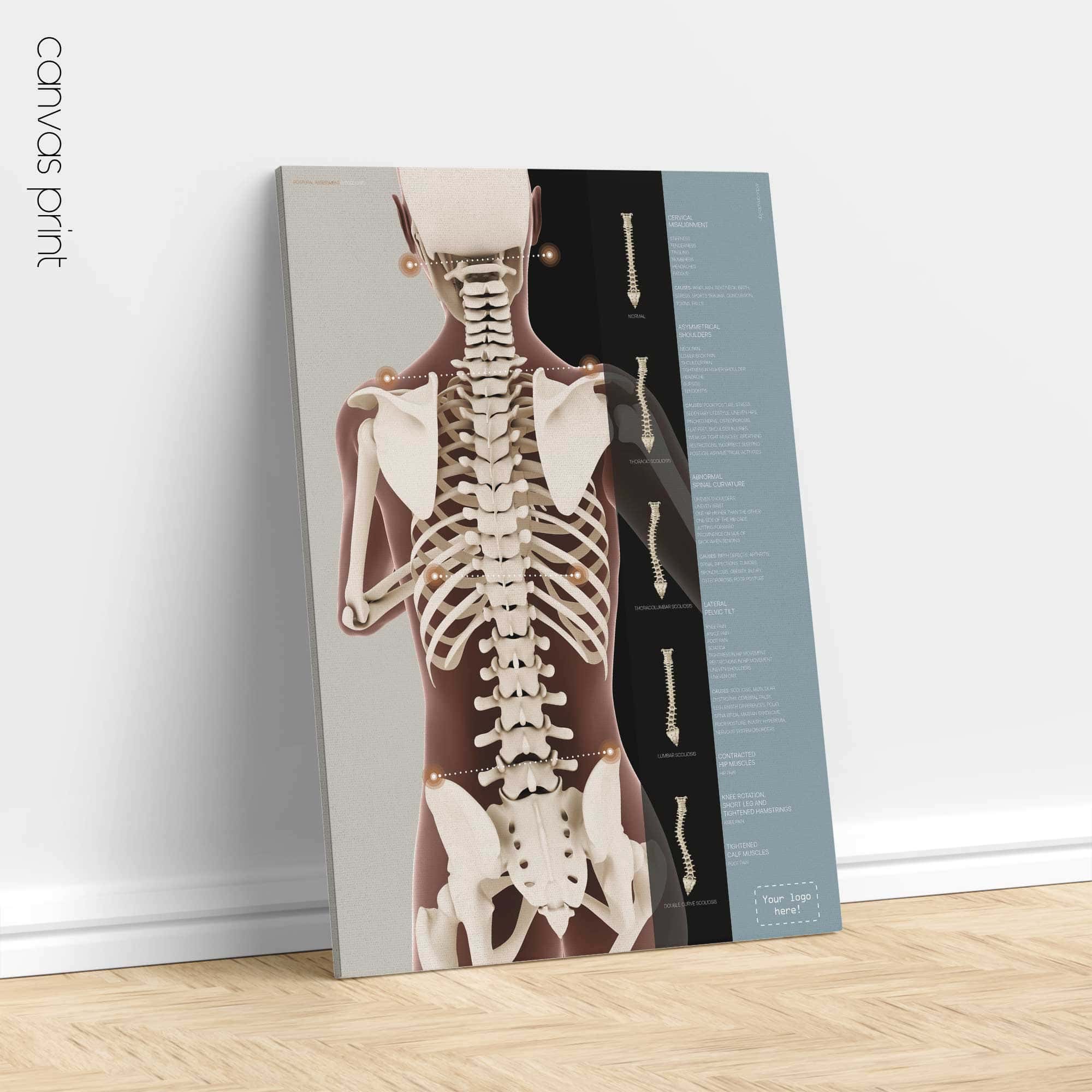
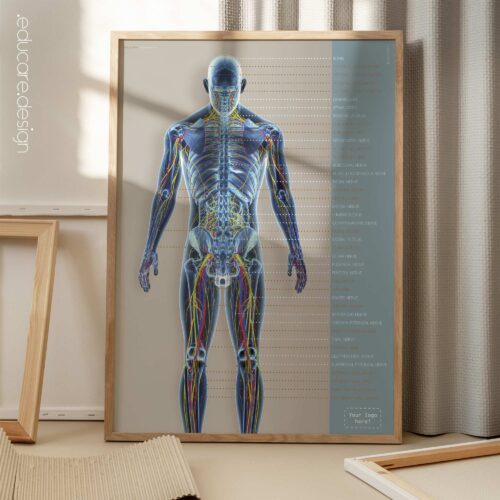
A comprehensive visual explanation of spinal disc pathology — from early degeneration to advanced structural breakdown. The Herniated Disc chart presents the progressive stages of spinal disc degeneration in a clear, clinically structured format. Rather than isolating disc herniation as a single event, this artwork illustrates the full pathological continuum — allowing patients to understand how structural changes develop over time.
The central full-column spine provides anatomical orientation, while surrounding panels break down key components:
Healthy spinal vertebrae and disc structure.
Stage 1: Disc degeneration (dehydration, minor fissures, early discomfort).
Stage 2: Prolapse (disc bulging with radiating symptoms).
Stage 3: Herniation (nucleus displacement with nerve compression).
Stage 4: Severe degeneration (loss of disc height, osteophyte formation, chronic pain).
Detailed sectional diagrams compare a healthy disc (annulus fibrosus, nucleus pulposus, nerve root, spinal cord) with a herniated disc compressing neural structures. This visual contrast transforms an abstract diagnosis into tangible anatomy.
A Structured Pathology Timeline.
Disc degeneration is rarely sudden. The chart demonstrates how dehydration, annular weakening and structural compromise may precede prolapse and eventual herniation. By mapping this progression, practitioners can explain not only what has happened — but why. The clear staging framework supports conversations around: Age-related wear and tear, Mechanical overload and repetitive strain, Acute injury, Nerve root compression, Radicular symptoms (pain, numbness, tingling, weakness), Loss of disc height and secondary degenerative change.
Rather than alarming patients, the design contextualises pathology within biomechanics. It reinforces that disc changes are progressive and often manageable with appropriate intervention, rehabilitation and load management.
A Daily Clinical Communication Tool.
This chart reduces explanation time while increasing understanding. Patients can visually identify where their condition may sit within the degenerative spectrum, improving compliance and informed decision-making. The minimalist anatomical style maintains professional clarity without visual clutter, making it ideal for chiropractic, physiotherapy, osteopathic and multidisciplinary spinal clinics.
Free customisation with your clinic’s name.
For this chart we offer to add your clinic’s name (or website address) for free! The name will go instead of the current sub-headline on the artwork; view an illustration of this in the image gallery.
 View this chart here on YouTube.
Black Edition.
This chart is available to order in a special black edition, which can be previewed in the image gallery.
🇬🇧 View more details of the English version.
🇮🇹 Vedi i dettagli della versione italiana.
🇪🇸 Ver detalles de la versión en español.
🇩🇪 Details zur deutschen Version anzeigen.
🇫🇷 Voir les détails de la version française.
🇳🇱 Bekijk details van de Nederlandse versie.
🇵🇹 Veja mais detalhes da versão portuguesa.
🇸🇪 Se fler detaljer om den svenska versionen.
🇳🇴 Se flere detaljer om den norske versjonen.
🇩🇰 Se flere detaljer fra den danske version.
Make it part of your clinic!
⬇ Order here.