
Understanding the Organs & Endocrine System — A Visual Guide for Clinics.
Hormones may be unseen, but their effects are everywhere: regulating growth, metabolism, mood, reproduction, and stress response. Together, the glands and organs that make up the endocrine system form one of the body’s most important networks. Yet for patients, the role of this system is often confusing.
The endocrine system includes the pituitary gland, thyroid and parathyroids, adrenal glands, pancreas, and reproductive organs, as well as hormone-secreting functions in the kidneys, heart, digestive tract, and even bones. Through chemical messengers, these structures communicate across the entire body, influencing how we feel and function each day.
For many patients, connecting symptoms like fatigue, weight fluctuations, or irregular cycles back to hormone activity can be difficult. This is where visual aids change the conversation. A clear anatomy chart gives structure to complex explanations. A clinician can trace the pathway from thyroid to metabolism, or from pancreas to blood sugar control, showing how invisible processes produce visible effects.
In practice, this transforms consultations. A patient struggling with stress can see how the adrenal glands regulate cortisol, while someone managing diabetes can better grasp the pancreas’ role in insulin balance. Instead of abstract discussion, the chart anchors explanations in something visual and memorable.
Visual tools also build confidence. Patients who understand the link between organs and hormones are more likely to trust treatment plans and feel empowered in their care. For clinics, this means smoother consultations, stronger communication, and a more professional environment.
The Organs & Endocrine System Anatomy Chart was designed to bring clarity to a complex subject. Clean, accurate, and visually engaging, it supports practitioners and patients alike by making one of the body’s most intricate systems easier to understand.
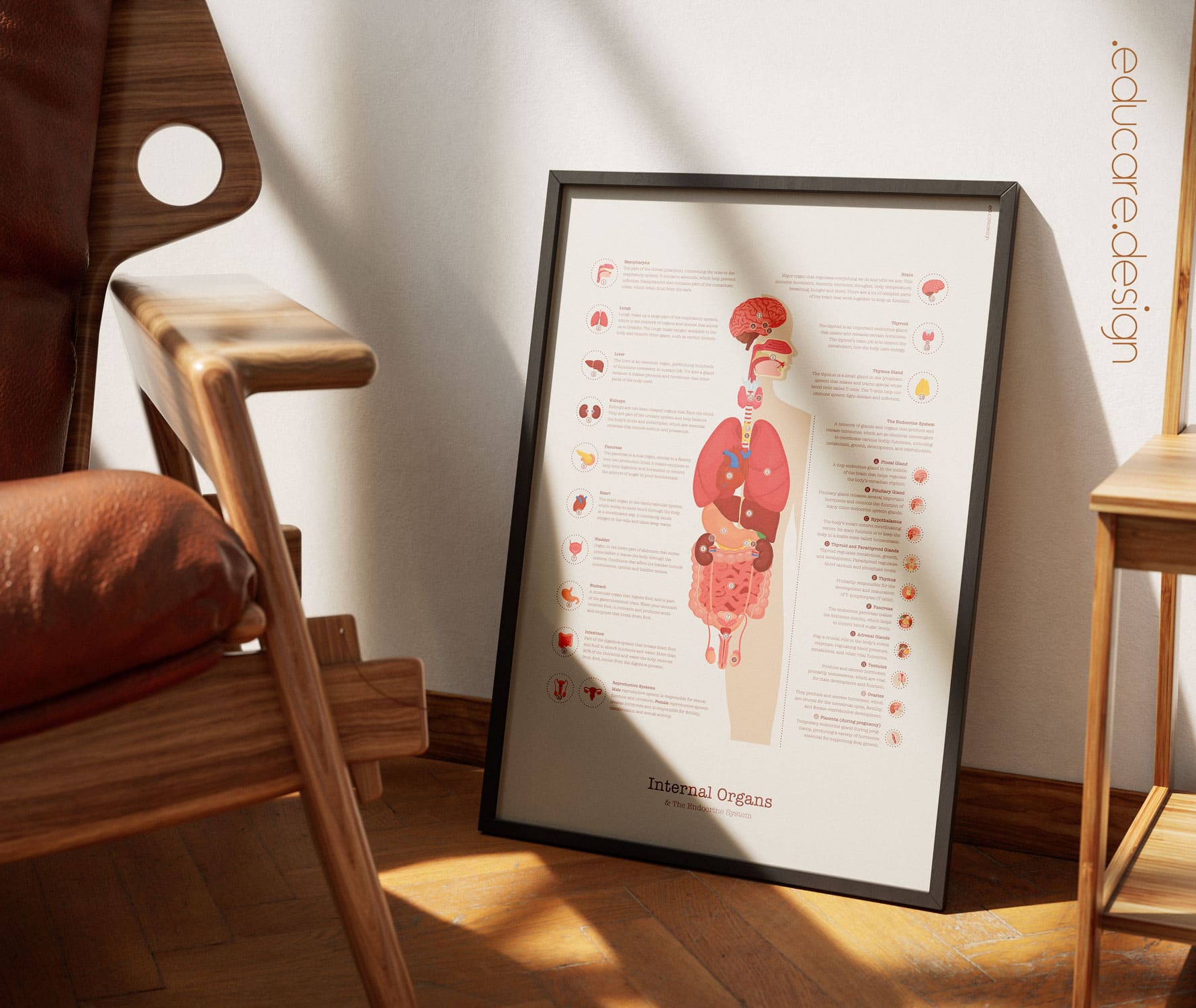
Why Visual Design Matters in Clinical Education.
Modern clinics rely increasingly on visual communication. Clear, well-designed charts reduce patient confusion, improve recall, and enhance trust during consultation. Each educare.design artwork uses minimal form and colour to emphasise hierarchy and structure — a balance between aesthetic clarity and scientific precision.
FAQ.
Q1: Why is visual anatomy useful in explaining endocrine function?
Because visuals reduce cognitive load, helping patients grasp hormone relationships faster than text alone.
Q2: Can this chart be customised with a clinic logo or language?
Yes — all artworks can be customised to include either a clinic’s logo, the clinic’s name or website address, and all charts are available in 10 languages!
Q3: How accurate is the medical information on the chart?
Each chart is designed using verified anatomical references and reviewed by clinical professionals to ensure visual and scientific accuracy while maintaining a modern, minimal aesthetic.
Q4: How can visual anatomy charts improve patient communication?
Clear visuals reduce confusion during consultation, helping patients understand diagnoses and treatment plans faster. Clinics report improved patient trust and engagement when using visual anatomy aids.

From Anatomy to Understanding.
Clinics, universities, and health educators use these designs as bridges between professional expertise and patient comprehension. By displaying the endocrine and organ systems together, this artwork turns a complex diagram into a practical conversation piece — ideal for both education and reassurance.
👉 Explore the charts here:
Organs & Endocrine System Chart (01) and Organs & Endocrine System Chart (02).
Learn More.
Explore related anatomy charts that connect directly with the endocrine system:
The Lymphatic System, The Circulatory System, and other Anatomy Charts.