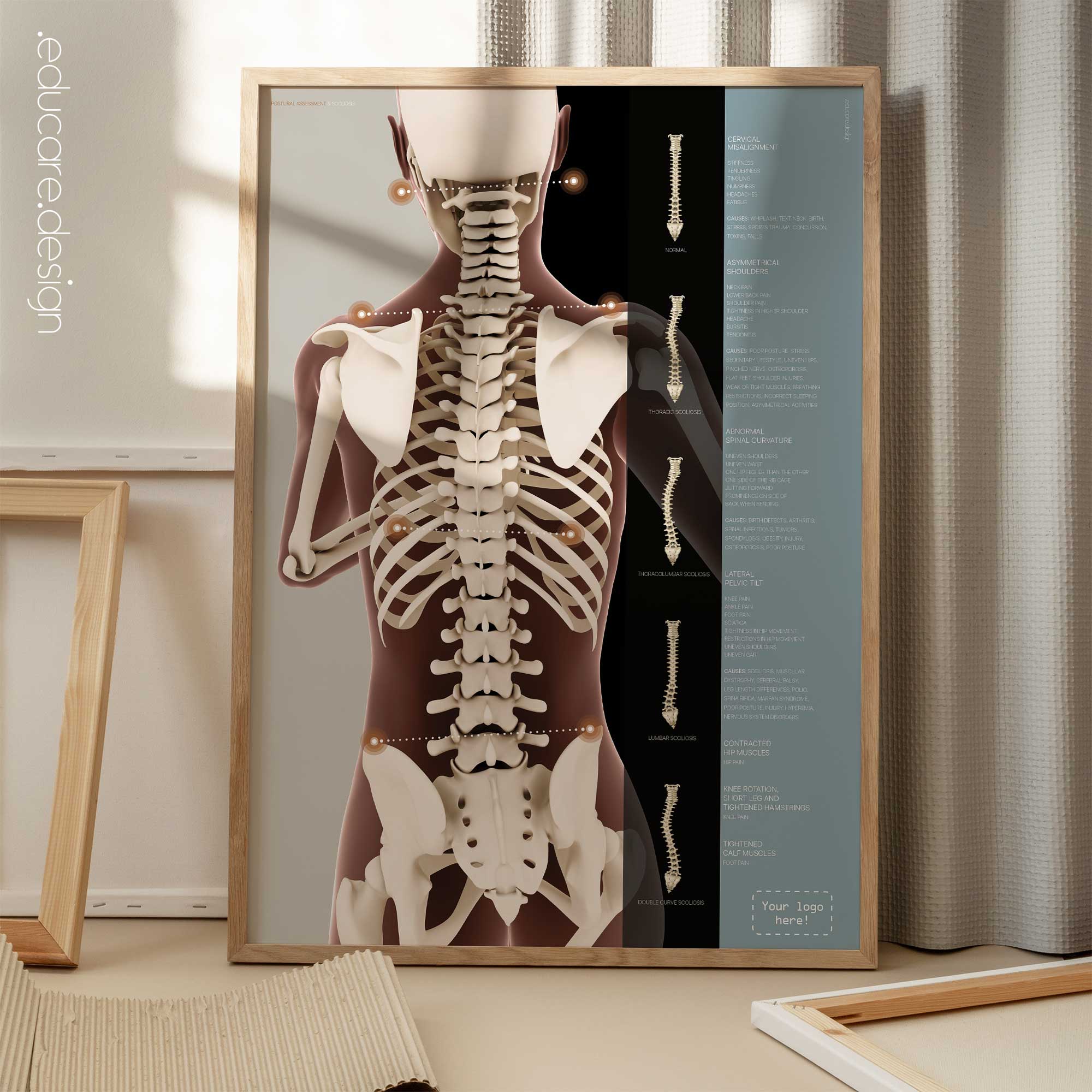
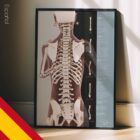
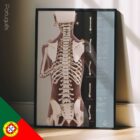
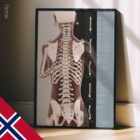
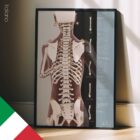
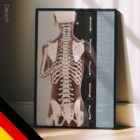
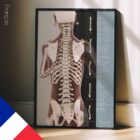
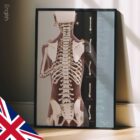
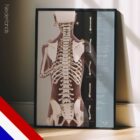
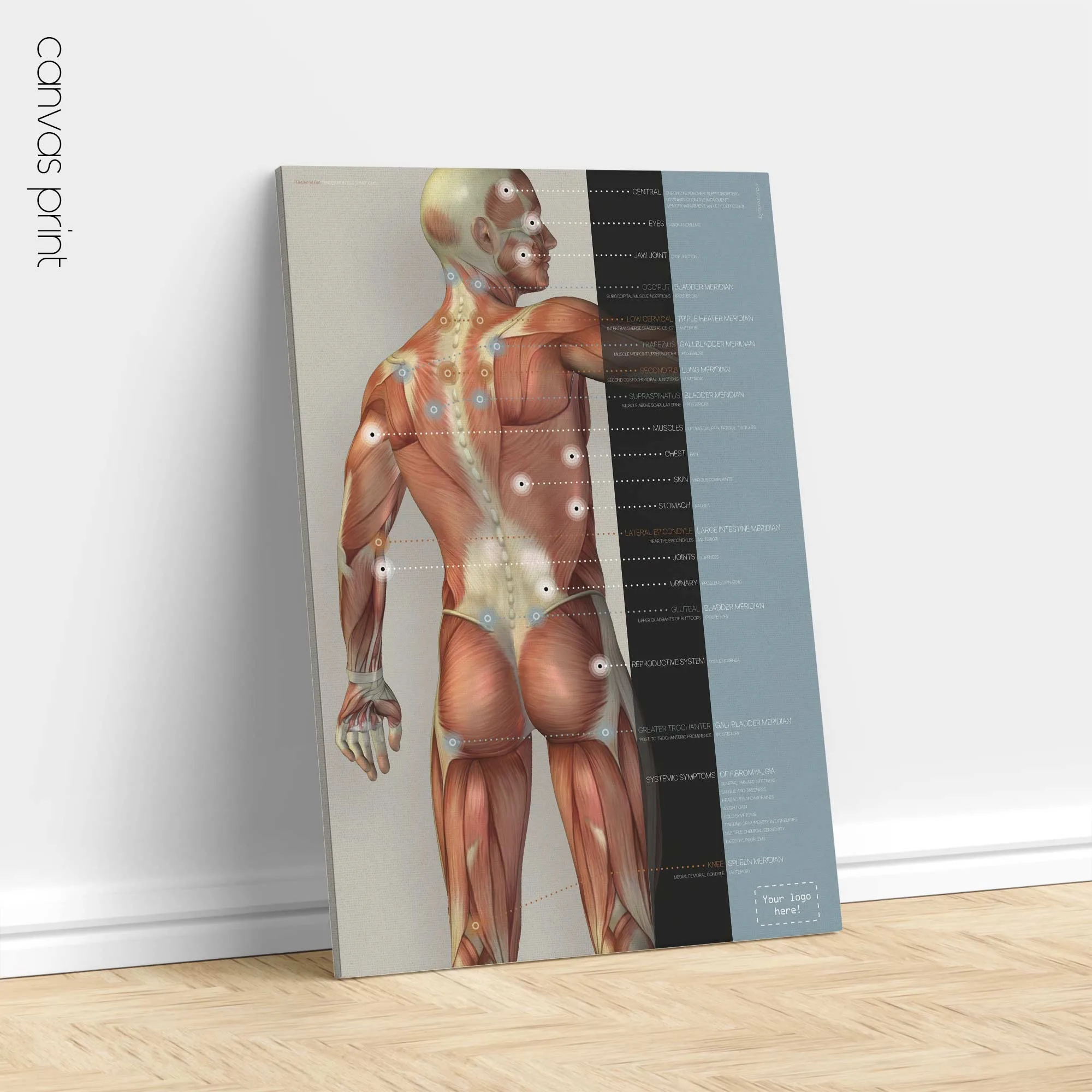
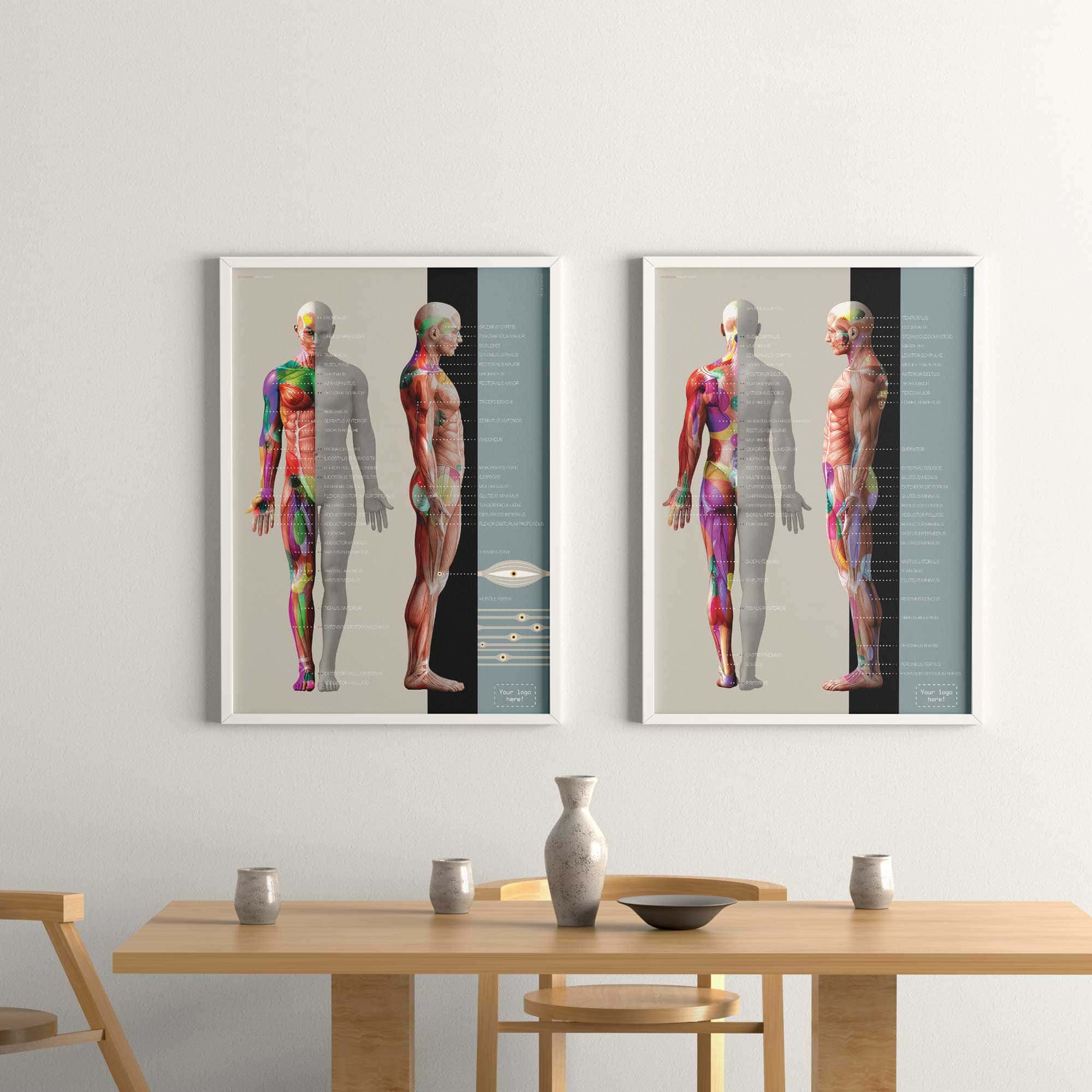
Alignment, Asymmetry & Spinal Curvature Patterns; this Postural Assessment and Scoliosis Chart presents spinal imbalance as a measurable structural reality rather than a vague visual observation. Designed with clinical clarity, the artwork maps common alignment deviations and correlates them with typical symptom patterns and compensatory mechanisms.
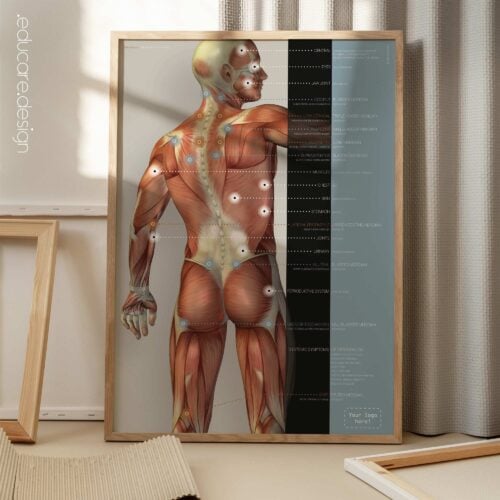
The central posterior anatomical view highlights key postural reference points across the cervical spine, shoulders, rib cage, pelvis and lower limbs. Visual markers indicate asymmetries such as cervical misalignment, uneven shoulders, thoracic deviation, lateral pelvic tilt and muscular imbalance. This structured layout allows practitioners to anchor patient complaints directly to observable biomechanical findings.
Alongside postural assessment markers, the chart presents clearly differentiated scoliosis patterns: thoracic scoliosis, thoracolumbar scoliosis, lumbar scoliosis and double-curve scoliosis. Each curvature type is shown in comparison to normal spinal alignment, reinforcing how deviation alters load distribution and muscular demand.
Structural Imbalance & Functional Consequences.
The artwork supports explanation of how postural deviations may contribute to:
Neck stiffness and headaches.
Shoulder imbalance and tension.
Rib cage asymmetry.
Pelvic tilt and gait irregularity.
Lower back strain.
Muscular overuse patterns.
Rather than isolating symptoms, the chart visually connects structure to function, helping patients understand how compensatory patterns develop over time.
Early Recognition & Clinical Dialogue.
Scoliosis awareness is strengthened through clear visual comparison. By distinguishing thoracic, lumbar and combined curvature patterns, the chart assists in early recognition and structured monitoring. It supports conversations about growth-related changes, muscular imbalance, postural habits and long-term spinal health.
Importantly, the design does not alarm — it clarifies. It enables evidence-based dialogue around assessment, monitoring, corrective exercise, stabilisation strategies and referral when necessary.
A High-Impact Educational Tool.
In consultation rooms, this chart becomes an authoritative reference point. Patients can immediately identify visible asymmetries and better understand how structural alignment influences comfort, movement and performance. The clean aesthetic ensures clarity without distraction, maintaining professional credibility. Ideal for chiropractic, osteopathic, physiotherapy, orthopaedic, rehabilitation and scoliosis-focused clinics.
 View this chart here on YouTube.
🔥 This artwork is part of a set with a 25% discount, as seen here.
🇺🇸 View more details of the English version.
🇮🇹 Vedi i dettagli della versione italiana.
🇪🇸 Ver detalles de la versión en español.
🇩🇪 Details zur deutschen Version anzeigen.
🇫🇷 Voir les détails de la version française.
🇳🇱 Bekijk details van de Nederlandse versie.
🇵🇹 Veja mais detalhes da versão portuguesa.
🇸🇪 Se fler detaljer om den svenska versionen.
🇳🇴 Se flere detaljer om den norske versjonen.
🇩🇰 Se flere detaljer fra den danske version.
Make it part of your clinic!
⬇ Order here.